
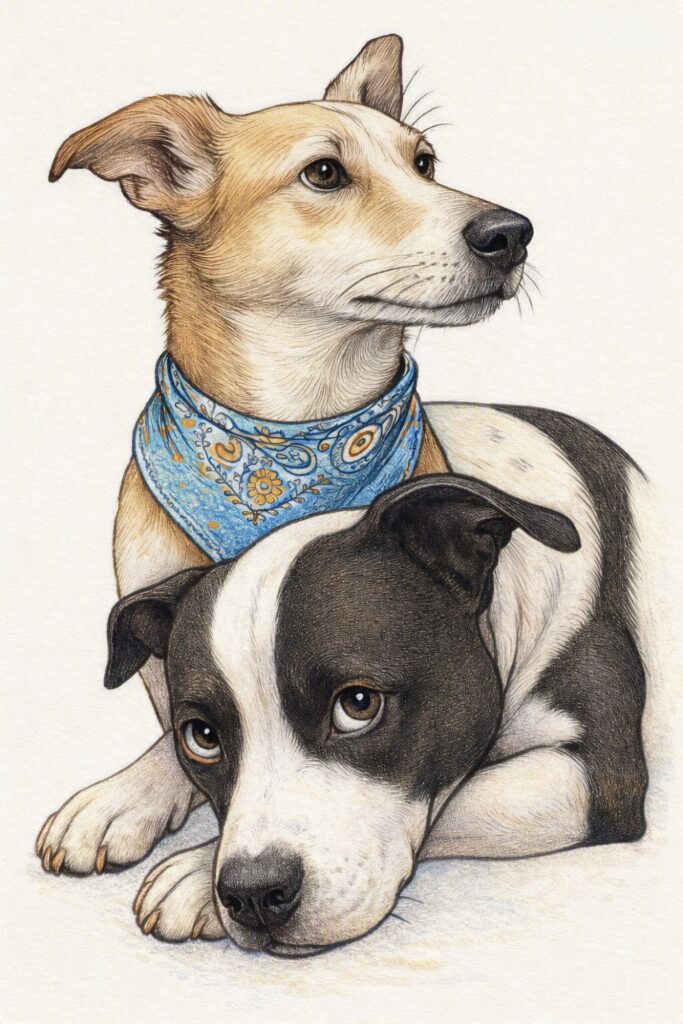
Choosing a size is one of the trickiest parts of ordering a portrait, because a number like “16×20 inches” is hard to picture. Too small and it gets lost on a big wall; too large and it overwhelms a cosy room. This guide helps you choose with confidence, and includes a simple trick for testing a size before you order.
Remember: the frame adds size
The size of the drawing isn’t the size on your wall. A mat (the card border around the artwork) typically adds a few inches on each side, and the frame adds more. An A3 drawing (about 12×16 inches) with a generous mat and frame can easily become around 18×22 inches on the wall. Keep that in mind when measuring your space.
Test it with paper and tape
The most reliable way to choose: cut paper or cardboard to the framed size you’re considering (newspaper sheets taped together work fine) and stick it on the wall with painter’s tape. Leave it up for a day. Walk past it, sit on the sofa and look at it. You’ll know quickly whether it feels right, too timid or too dominant.
Common sizes and where they work
A4 / 8×12 inches
Good for desks, shelves, bedside tables and small wall spaces like beside a door or in a hallway. A single head-and-shoulders portrait of one person or pet fits well. It’s also a sensible gift size when you don’t know the recipient’s wall space.
A3 / 12×16 inches
A versatile size. It works above a small side table or desk, in a bedroom, or as part of a gallery wall. It gives a single face more presence and has room for two heads side by side.
16×20 inches
A strong single piece for a bedroom wall, home office or narrow living-room wall. It suits a single subject with some body showing, or two to three heads.
18×24 inches
This starts to be a feature piece. It works above a console table, a bed or a smaller sofa. It’s a good size for couples, families of three or four, or multiple pets.
20×30 inches and 24×36 inches
Statement sizes for living rooms, above a sofa or fireplace, or at the end of a long hallway. Good for family groups, full-body pets, or a single dramatic face drawn large.
30×40 inches
Very large, intended for big walls with high ceilings or open-plan spaces. A face drawn at this size is larger than life and has real impact. These take the longest to draw and need careful framing and shipping.
Rules of thumb for placement
Above furniture
A common guideline is that art above a sofa, bed or sideboard should be roughly half to three-quarters the width of the furniture. Much narrower and it looks lost; wider and it looks crowded.
Height
Many galleries hang art so the centre is roughly at average eye level, around 57–60 inches (145–152 cm) from the floor. Above furniture, leave a gap of roughly 6–10 inches between the top of the furniture and the bottom of the frame so they read as a group.
Viewing distance
Think about where people will see it from. A portrait in a hallway is seen up close, so detail matters more than size. One above a fireplace is seen from across the room, so it needs to be bigger to read clearly.
Face size matters too
With portraits there’s another consideration: how big the face is on the paper. A full-body dog on an A4 sheet will have a tiny face, with little room for detail in the eyes and expression. The same dog as a head-and-shoulders portrait on A4 will have a much larger face. If expression is what matters most to you, either crop tighter or go bigger.
For multiple subjects, each face needs enough space. As a rough guide, two heads are comfortable from A3 upward; four or more usually need 18×24 inches or larger.
Orientation
Most single portraits are portrait-oriented (taller than wide), which suits one face. Groups often work better in landscape orientation (wider than tall), especially above sofas and beds. Tell the artist where it will hang so they can suggest the right orientation.
Gallery walls
A pencil portrait can anchor a gallery wall of family photos and prints. A3 or 16×20 inches often works well as the central piece, with smaller frames around it. Because graphite is black and white, it sits comfortably with black-and-white photos and simple line art.
Standard sizes save money on framing
Ready-made frames and mats are available in common sizes, often much cheaper than custom framing. Before ordering, check which frame sizes are easy to buy where you live. Sizes like A4, A3, 8×10, 11×14, 16×20, 18×24 and 24×36 inches are widely stocked in many countries, though availability varies by region.
Paper size vs image size
Ask whether the drawing fills the sheet or has a white border. A drawing on a 16×20-inch sheet may have an image area a little smaller, which matters when choosing a mat window.
Quick decision guide
- Gift, unknown wall: A4 or A3
- Desk, shelf or bedside: A4
- Hallway or beside a door: A3 or 16×20
- Above a bed or small sofa: 18×24 or 20×30
- Above a large sofa or fireplace: 24×36 or larger
- Several people or pets: 18×24 or larger
If you’re torn between two sizes, send us a photo of the wall with its rough measurements and we’ll give you our honest opinion. We’d much rather you end up with the size that suits your room than the biggest one on the list.